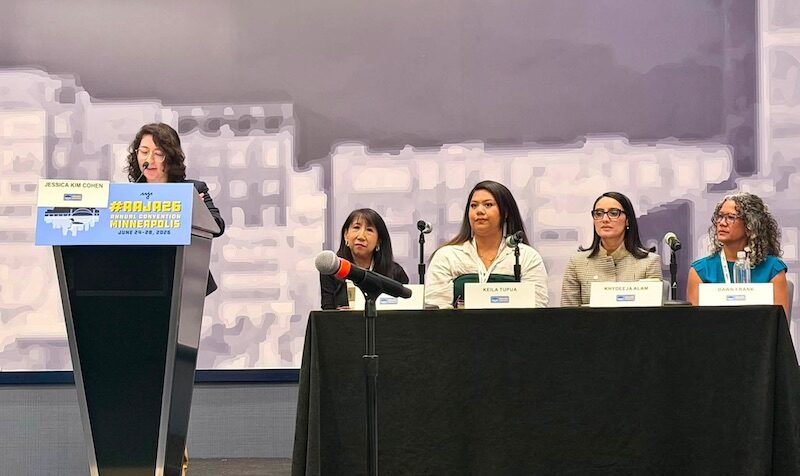
Regie Baloyos, the Executive Director of Sacramento-based Asian Resources Inc., started her remarks by asking for a show of hands. “How many people pay only $500 a month for rent or a mortgage? How many can feed a family on $200 a month?” No hands went up. Yet those are the budgets many of the refugee and immigrant families her Sacramento nonprofit serves are trying to live on.
Baloyos joined Sean Cremin from the Public Policy Institute of California and Gabriel Young from MOSAIC at the AAUC Unity Summit in Sacramento on October 7 to address cost of living issues faced by AAPI communities. The panel discussion was moderated by Sayali Amarapurkar of SEWA Asian Indian Family Wellness.
A 2026 survey by AAPI Data and the National Council of Asian Pacific Americans found that 58 percent of Asian American and Pacific Islander adults name the cost of living and inflation as the country’s most important problem. But is this not just an AAPI issue. In California, the Public Policy Institute of California found in February that 61 percent of likely voters consider candidates’ affordability positions very important, with majorities across parties, regions and demographic groups agreeing.
“I feel like I’m being priced out of opportunity in California,” one worker told PPIC researchers, a line research associate Sean Cremin said has stayed with his team.
A Squeeze Nearly Everyone Feels
Prices have risen about 30 percent since 2020, Cremin said, far above the Federal Reserve’s 2 percent annual target, and essentials like rent, transportation, utilities and childcare rose even faster. Wages climbed too, but inflation ate much of the gain, especially for low- and middle-income families.
The deeper problem is long-term, he argued. In the 1960s, more than half of Californians ages 30 to 34 owned a home; today about 30 percent do. Childcare for an infant or preschooler can take up to 28 percent of a median family’s income. Health premiums have grown three times as fast as earnings since 2000. Since 1980, real wages for low- and middle-income Californians grew 4 to 15 percent, compared with 70 percent for the top tenth of earners. Middle-wage jobs, the stepping stones to the middle class, have barely grown since 2000.
Those pressures don’t stop at any ethnic boundary. Nationally, a record 22.7 million renter households, about half of all renters, were cost-burdened in 2024, spending more than 30 percent of income on housing, according to Harvard’s Joint Center for Housing Studies. Among renters earning under $30,000, 83 percent were financially strapped.
In a January poll by AAPI Data and the AP-NORC Center, about half of AAPI adults wanted the government to prioritize the cost of living, compared with about a third of U.S. adults overall. In the 2026 AAPI Voter Survey, 90 percent of Asian American voters and 97 percent of Native Hawaiian and Pacific Islander voters called it very or extremely important to their vote.
What the Averages Hide
Broad numbers mask the hardest cases. Young said 33 percent of AAPI Californians are housing cost-burdened, slightly below the 37 percent national figure. But in the Afghan community, that number is 67 percent. The median AAPI household earns about $116,000, but for Burmese Americans, it is about $74,000. In multigenerational households, like the one that Young grew up in, people are kept of of the workforce to become their family’s caregiver.
Cremin pointed to occupational segregation, in which immigrants, women and people of color are concentrated in retail, domestic work and hospitality, jobs that often lack benefits, flexible schedules and a path upward. Baloyos says she sees immigrant professionals arrive with degrees that must be re-evaluated, sometimes requiring more classes before they can work in their field. In some families, cultural norms discourage women and girls from working or studying. Even native-born low-income families struggle with eligibility forms, she said, “because that’s not part of their lives.”
The data needed to see these gaps is itself under threat. In September, the Trump administration proposed removing race and ethnicity questions from the 2030 census, which has asked about race since 1790. The administration says that information isn’t needed for the census’s constitutional purpose of counting the population. Young warned that without it, communities could be erased from funding decisions. “Without that data, we can’t make those grant proposals,” he said.
What Community Leaders Can Do
If affordability is a shared crisis, the panelists argued, it calls for shared solutions, and community organizations are positioned to lead.
Build coalitions across racial lines. Young urged AAPI groups to share their data with Black, Latino and other communities so legislators see that affordability isn’t one group’s concern. That shared message, he said, is how a “coherent, coordinated movement” gets heard in Sacramento.
Speak with one voice. Too many separate advocacy days pushing different bills confuse legislators, Young said. His answer is “coherence, coordination and communication.” MOSAIC’s 2026 platform tries to do that, uniting coalitions behind priorities that include renewing the state’s Stop the Hate grants, protecting tenants, promoting social housing, defending mixed-status families and expanding language access.
Invest in trusted messengers. “You can have a program and then you do not have the trusted messenger that supports that program, so therefore that program will not work,” Baloyos said. Bilingual, bicultural case managers who can walk clients through forms and credential reviews are what make resources usable.
Put disaggregated data to work. AAPI Data’s AANHPI Community Explorer lets organizations pull census figures by ethnic group for grant proposals and testimony. “At the end of the day, data translates into funding,” Young said. Since Congress has final say over the census, leaders can also tell their representatives where they stand on the race question.
Get out the vote. Election Day is November 3, with a governor’s race and ballot measures on taxes and education funding at stake. Nonpartisan groups can help households make a voting plan.
Grow the next generation. After seeing low-wage workers hit hardest during COVID, Asian Resources launched a youth executive academy to prepare young people to represent their communities in leadership.
Cremin urged leaders to see affordability not as the price of eggs but as a question of upward mobility. Framed that way, it is daunting, he said, but it “opens up a lot of policy proposals and possibilities” on prices, wages and the safety net. And it is a frame every community can share.