On April 23, AAUC hosted an online town hall meeting to examine the human cost of America’s wars and the generations-long trauma they leave behind. The guest speaker was Kim Sin, the Co-founder of Cambodian American Partnership of Minnesota. The meeting was moderated by Ted Fong, Executive Director of AAUC. Jack Hanna, a retired attorney and VP of AAUC, provided the historical context.
Vietnam
Hanna began with Vietnam, the war that perhaps most durably shaped the Americans’ pessimistic view of war and later the demographic map of cities across the U.S. “First, you have the justification, which was to stop the spread of communism,” Jack said. “Then you have escalation, and then came the overwhelming military deployments.” Millions of soldiers and civilians died. The Khmer Rouge’s rise and the resulting killing fields became a catastrophe in itself, claiming two million Cambodian lives. This produced its own wave of refugees in the years that followed.
“Once you go into a country that is not your own to fight a war, you have to develop alliances and relationships with the people in the community there,” Hanna said. “And if you lose the war and retreat, those people are at risk.” The obligation to those allies was real, he argued, but the plan to honor it was almost entirely absent. “We had no specific plan how to assist them thereafter.”

What emerged from that failure of planning was the U.S. Refugee Act of 1980 and the creation of the Office of Refugee Resettlement, the modern framework for absorbing displaced populations, built not from foresight but from a moral reckoning after the fact. “That began the system, so to speak, of how we have these immigrants come to the United States and be absorbed and acclimated,” The system has improved over the decades, he acknowledged, but it remains far short of what a best-case response would look like.
Somalia
Somalia, Hanna said, represented a somewhat different kind of intervention, one driven as much by humanitarian crisis as by ideology. A devastating famine and a civil war had torn the country apart by the early 1990s, and the United States entered in 1992 ostensibly to stabilize the situation. But he was careful not to reduce it to simple altruism. “Many times there are other factors involved that are above and beyond just ideological political matters, including corruption, including famine, and other countries’ ulterior motives for their own political and economic purposes.”
The result was nearly 98,000 Somali immigrants eventually making their way to the United States, with the largest concentration settling in Minnesota, a fact that would loom over the broader discussion of the ICE incursions (the topic that AAUC upcoming summit in Minneapolis plans to address). What distinguished the Somali community, he argued, was the degree to which it had organized itself. “There was a high rate of naturalization that occurred for them, and that is very, very unique, and I think a reflection of the strength of the self-organization that the community has gone through.” It was a point that would echo later, when Kim Sin held up the Somali community as a model his own Cambodian community was still striving to emulate.
Iraq and Afghanistan
Hanna grouped the post-9/11 wars in Iraq and Afghanistan together, not because they were identical, but because they shared a common origin point and a common pattern of consequences. Both were launched in the wake of September 11, 2001, though the justifications diverged sharply.
The Iraq War, he said, was sold to the American public and to Congress on the claim that Saddam Hussein possessed weapons of mass destruction. “Did not exist,” Hanna said flatly. “A complete failure as far as the justification is concerned.” The humanitarian consequences were staggering: over 600,000 Iraqis killed, millions more displaced. American forces withdrew in 2011, only to return in 2013 and 2014 when the vacuum they left was filled by ISIS. “We still have about 2,000 troops there,” he noted, a presence that continues without a clear endgame, two decades after the original invasion.
Afghanistan presented what Hanna called a more defensible justification, given Al-Qaeda’s operational presence there following 9/11. But the outcome was similarly grim. Over 100,000 Afghan civilians died, along with 2,400 Americans. And the withdrawal, when it finally came in August 2021, was chaotic. The Taliban moved swiftly to consolidate power, and the Afghans who had spent years cooperating with American forces — translators, administrators, soldiers, civil society leaders — were left acutely exposed. “The consequence was disastrous,” Hanna said. “And we still suffer the consequences of that political, economic, and military defeat.”
More than 190,000 Afghans eventually immigrated to the United States on the grounds that they had assisted American efforts and that the U.S. bore a moral and legal obligation to protect them from Taliban retribution. But Hanna argued that obligation has since been abandoned. “Sadly, in my opinion, America has failed with regard to the obligations it has to the Afghans,” he said. “And now is not letting any of them in, and just this past week has decided to send them to the Congo.”
Syria
Hanna saved Syria for last, describing it as personal as it is the country of his own heritage. A civil war that ground on from 2011 to 2025 produced what he called one of the largest refugee crises in recent history: 13 million people displaced, 7 million of them driven across international borders. “It was one of the largest groups of refugees since WWII,” he said. The United States absorbed approximately 50,000 of those community members, a fraction of the total, and a number that has now effectively been reduced to zero under the current administration. “That has been practically completely terminated,” Hanna said, “as it is with the Afghans, since the new administration has come into power.”
Taken together, he argued, these four cases, and the dozens of other interventions that Fong would display in a closing slide, reveal something important about the relationship between American foreign policy and American demographics. “These are just some of the examples of what’s occurred in the past,” Hanna said. “There are common experiences. America goes into these wars, and what are the consequences of us leaving — and in many instances having failed military efforts — and the refugees and immigrants it creates? The lessons are there, if we choose to learn from them.”
Kim Sin’s Story
After Jack provided the historical context, the town hall’s guest speaker offered the human story behind it. Kim Sin is the co-founder of the Cambodian American Partnership of Minnesota and a longtime community advocate based in Rochester. He was three years old when his family fled Cambodia.
Describing his earliest memories of the camp on the Thai-Cambodian border, he said, “I thought that was my home. Then I got very curious, wanting to know why I could not leave the barbed wire fence.” His mother’s answer came slowly and heavily, Cambodia was under the Khmer Rouge, and because his father had been a soldier, the entire family would have been executed had they stayed. “My family had to take a risk and escape,” Sin said. “All the educated, all the wealthy, all the people with knowledge were executed because they were considered a risk and a rebellion against the new government. That’s why we are here.”

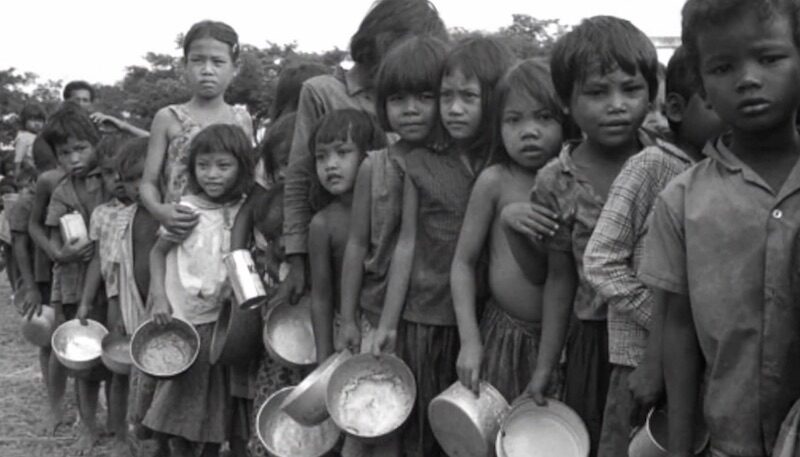
Sin spent three years moving between camps before being flown to the Philippines for six months of medical screening and processing. The camps were orderly in their way, governed by permission slips and barbed wire, rationed food and routine uncertainty. “Me and my sister would have to line up, holding the same bowl, and we would get a rice porridge,” he recalled. “My mom would sit in the sun, waiting for food distribution.” There was no school. There was no stability. There was only the next camp, and then the next.
Aid workers showed refugees American films, glimpses of a country that seemed almost fantastical. “It showed, like, it was heaven on earth,” Sin said with a laugh. “Big houses, mansions, luxury cars. I was just praying to come to the U.S.” He paused. “When I got to the U.S., the perspective that Hollywood portrayed was not the way that I imagined.”
Arriving in America
Kim was six years old when he landed in Rochester, Minnesota, speaking not a word of English. The support systems of the early 1980s were, by his account, almost nonexistent. “We didn’t have a really supported system in place back in the early 80s,” he said. “It was new to the U.S. government, they didn’t even have any structure.”
Families were required to report to government offices every three months to maintain healthcare and cash assistance, with little guidance on how to navigate those bureaucracies. Transportation was a constant problem. “We didn’t know how to use a taxi. We didn’t know how to use the transportation that a city offers. There was no one to help and guide our community.” Grocery stores were out of reach. The housing they were placed in was cheap, but it was also isolated. “They kind of threw us into a community,” Sin said. “They put us in the worst of the worst.”
Those who needed help getting to a doctor’s appointment had to pay out of pocket for assistance, a crushing burden. “If you had six people in your family, you’d have to pay more. The most would be $100, the least $40. But back in the 80s, that was a lot of money.” Even small costs added up to impossible math for families with no income, no language, and no map of the system they’d landed in.
And then there was the matter of who Sin was at home versus who he was expected to become at school. “I had to live in two cultures,” he said. “My parents were trying to pull me not to stray away from Cambodian culture, but at school, my peers, the environment — it was pulling me to live and be an American. It was very, very tough.”
The Weight That Carries Forward
Fong asked Sin to explain intergenerational trauma, which comes up in a lot of conversations he has with the Southeast Asian American community.
“A lot of the parents and grandparents were experiencing the Khmer Rouge War,” he said. “They saw people getting killed in front of them, family members executed in front of them. So coming to a new country, even though the kids are growing up here or born here, there’s a lot of restrictions.” The fear that had kept parents alive in Cambodia, including hypervigilance, secrecy, distrust, followed them into American living rooms and didn’t know how to stop. “The trauma of their past experience during the Khmer Rouge War carried on with them.”
When children pushed back, as American children do, parents often couldn’t distinguish normal adolescent independence from genuine danger. “They fear of losing their kid. They hear about kidnapping, people getting murdered in America. So the trauma just keeps going.” The result was a growing distance between generations, and within that distance, damage. “There’s a gap that keeps on pushing and pushing, and there’s tension, and there’s abuse in that, where the father feels the kid is not giving them respect. And when they come to a new country, the respect is gone.”
Fathers who had been engineers, lawyers, or government officials in Cambodia arrived in America to find that none of it transferred. “Doctors, lawyers, engineers — when they come here, they end up cleaning toilets, doing housekeeping work, because their status in Cambodia did not carry over,” Sin said. “Knowing that their status as a toilet cleaner is an embarrassment for them, it was tough. They feel degraded.” Without professional standing, without language, without a pathway back to the life they had known, some turned to alcohol, gambling, or worse. Their children watched. “Parents become alcoholic, they have gambling issues, and that makes it harder for the younger generation — they’re being pulled and prevented from moving on.”
Yen Marshall, the AAUC’s board president, joined the conversation. She and her family fled Vietnam by boat. “Depending on how we left that situation, we have a different view on how to kind of move forward,” she said. But she also described a dynamic that played out in households across every immigrant community on the call: children who learned English faster than their parents suddenly found the family’s power structure quietly, uncomfortably reversed. “In a short time, your kids know more than you, they’d be your translator when you go and ask for help. With that table turned around, the frustration builds, and when they’re not doing things the way that you feel they should, the conflict inside the house is huge.” Her father, who had run his own business in Vietnam and employed multiple people, arrived in America washing dishes in a restaurant. The shame and disorientation of that fall, she said, had nowhere to go. “There’s no way for them to communicate it out.”
The consequences showed up in statistics that still trouble Sin today. “In the 80s and 90s, there was a high number of suicides. We see a lot of young generation, they shot themselves, they couldn’t deal with the issues at home.” Girls dropped out of school, became pregnant in junior high. Boys joined gangs. “They were using a high number of drugs that was causing them to be suicidal, and some of them overdosed. Some of them died in their cars, sleeping in the car.” He paused. “That was a big issue within our community.”

Fong asked about the comparison to other Southeast Asian immigrant communities and whether Cambodians had fared differently than Vietnamese or Hmong Americans. Sin didn’t soften his answer. “We are considered the lowest and least educated community. The last time I got the report, 58% of Cambodians are failing in school.” He attributed part of this to a wound that is uniquely Cambodian.
Michael Siv, a Sacramento-based advocate and filmmaker whose own family fled Cambodia, joined the conversation, offering this grim distinction, “The Khmer Rouge is our own people. A quarter of the population massacred. There’s not a lot of dialogue about when your own kind just massacred your whole country.” He drew a pointed contrast with other refugee communities. “The Hmong can blame America, they can blame Laos or the Vietnamese government. But for Cambodians, nobody really talks about it. Your own people pretty much just massacred your whole country. So, there’s a mistrust in creating that conversation.” That silence, he argued, has made the communal reckoning necessary for healing almost impossible to begin, and has contributed to a fragmentation that distinguishes the Cambodian American experience from that of other Southeast Asian communities. Sin agreed: “It’s very hard and emotional for the elderly to share. A lot of tears. A lot of complication. We try, slowly, to get them to share their feeling about their past.”
What Healing Looks Like
Fong turned the conversation toward recovery, asking what communities and organizations are doing to address the psychological burden carried across generations. The responses from around the call converged on a single word: community.
Charlene Reyes, 19, a Sacramento member of the youth organization Young and Rooted and the daughter of immigrant parents said, “I can’t say much about what the older generation is doing to find healing,” she said. “But I know that even in the younger generation, kids my age, kids younger than me, they are affected by our parents’ past and the trauma they went through. It’ll always be with us, throughout the generations.” What has helped, she said, is simply not being alone in it. “A lot of kids of immigrants — I’m first generation, my mom was an immigrant, my dad’s an immigrant — it shows that there’s a lot of people, a lot of kids, that have parents that are like that. I’ve seen it help a lot of these kids. I’ve seen it help myself. To know that we all have the same sort of struggles, similar enough that we can understand each other without even talking about it.”
Yen Marshall echoed that, drawing on her own experience as a boat refugee from Vietnam. She described a particular burden that many first-generation immigrants carry but rarely name: survivor’s guilt. “A lot of people died on that journey leaving,” she said. “Being the survivors, we felt very lucky already. But what about all those who died and couldn’t make it?” That guilt, she argued, became a kind of fuel. “Part of the immigrants, the generation that came here, felt that it was their responsibility to make a difference, not just in their own lives, their family, but the community surrounding them.” Building up the community, she said, was how many first-generation immigrants processed what they had survived. But communication remained the great obstacle. The trauma left people frustrated and inarticulate, unable to express what they carried. “There’s no way for them to communicate it out.”
What she came back to, ultimately, was the same thing Charlene had said, and the same thing Kim Sin had said: the need for places where people can simply be together without explaining themselves. “Community is a place to unwind, to reconnect, to take a breather — even from your own family,” Marshall said. “Building a strong community where new immigrants, or even older immigrants who’ve been here for a while, can reach out and lean on you — I think that’s one of the best ways to move forward.”
Building the Basket Back
Sin closed the meeting with a message that was honest about the scale of the problem and clear-eyed about what it will take. The Cambodian community, he said, is like “a broken basket, we’re trying to weave that basket back together, but it’s just hard to pull that bamboo string back. It’s going to take many, many generations.”
His own model of leadership, he explained, is rooted in this: “I don’t need your money, but I need your participation. That’s the difference.” Through the Rochester Cultural Center, which he helped found, and through his work connecting with Somali, Vietnamese, and Hmong leaders across Minnesota, he has been studying what makes other communities resilient. “I see why they are so successful. It’s because they know how to support each other. And that’s what our Cambodian community needs.”
He saved his most direct words for the broader audience — for the non-immigrants and policymakers and fellow advocates on the call. “It’s hard to live in a situation where your family’s not educated, where your family doesn’t have the resources. We need to help them in a way that lets them move forward and be able to live the American dream.” He thanked AAUC for reaching out and asking the simple question: what can we do to help your community? “Coming together is so important,” Sin said. “I’m just one person. But how do I build new leadership. That is the challenge I see.”
In closing, Fong reinforced a broader argument that America has never fully accounted for the human cost of its foreign wars. A slide he shared at the close of the session catalogued dozens of military interventions over the past 60 years, from the Dominican Republic in 1965 to the current conflict in Iran. He called it, with sarcasm, “the U.S. military resume.” “We don’t really factor in the cost of refugee displacement when we enter these wars,” he said. “Each of these has produced displaced populations, people with varied stories and circumstances, coming to America.”