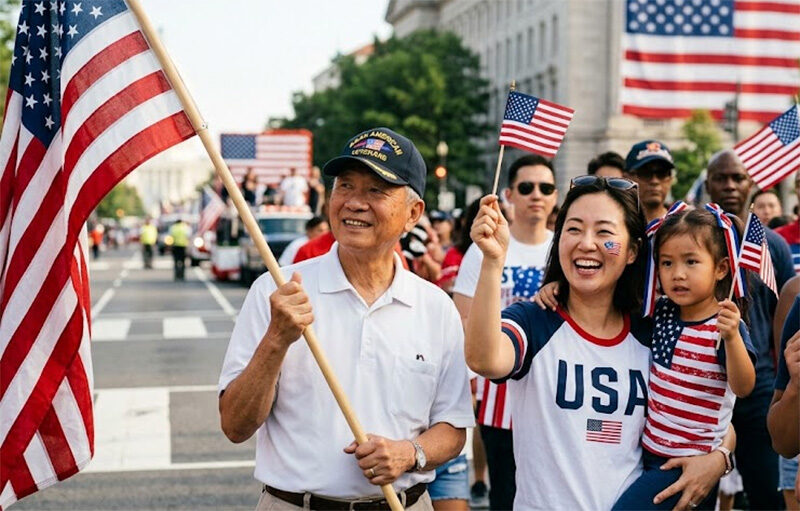

For many Asian Americans and Pacific Islanders, especially first and second-generation immigrants, the United States was once a beacon of hope. We arrived with dreams of prosperity, freedom, and fairness. We believed in the power of democracy, the dignity of hard work, and the promise that our children would inherit a better future. But today, that belief is being tested.
In the current global landscape, the U.S. still commands attention. Most nations cater to American interests, whether through trade, diplomacy, or investment. On the surface, it looks like the U.S. has won. But beneath that veneer lies a deeper question: at what cost?
Faced with a mounting national debt and a hollowed-out manufacturing base, the U.S. government is turning to tariffs and foreign investment to offset economic decline. These policies aim to revive dying industries and restore domestic production. But for everyday Americans, especially immigrant communities, the consequences could be severe.
Tariffs may raise prices on essential goods, from food to electronics, disproportionately affecting working-class families. If inflation rises while wages stagnate, we risk entering a period of stagflation, where economic growth stalls but the cost of living soars. For AANHPI households, many of whom run small businesses or work in sectors vulnerable to global shifts, this could mean tighter margins and fewer opportunities.
Beyond economics, there’s a growing erosion of the ideals that once drew us here. Democracy feels increasingly fragile. Political polarization, racial tension, and economic inequality have shaken our faith in the system. Many AANHPI individuals now ask: is this the America we believed in?
We’ve marched, voted, and spoken out, and yet too often, our voices are sidelined. The rise in anti-Asian hate, invisibility in mainstream narratives, and lack of representation in leadership have left many feeling alienated. The dream of belonging is being replaced by a quiet disillusionment.
So, has the U.S. won? Perhaps in influence. But if that victory comes at the expense of its people, especially those who believed in its promise, then it is a fragile triumph.
Now more than ever, the AANHPI community must come together, not just to reflect, but to act. We must amplify our voices, share our stories, and demand a future that honors the ideals we came for. That’s why the 2025 AANHPI Unity Summit on September 16–17 in Washington, D.C., is so vital.
Hosted by the Asian American Unity Coalition (AAUC), this year’s theme, “Building Solidarity Through Unity, Collaboration, and Advocacy,” calls us to rise above fragmentation and forge collective strength. The summit will convene over 150 AANHPI leaders, nonprofits, policymakers, and allies to strategize, advocate, and celebrate our shared heritage. From Capitol Hill visits to sessions on civic leadership, mental health, and cultural identity, it’s a space to reclaim our narrative and shape our future.
Let us stand together—not just in critique, but in hope. Let us reclaim the American promise, not as passive dreamers, but as active builders of a more just and inclusive future.
To learn more or register, visit asamunitycoalition.org/summit.