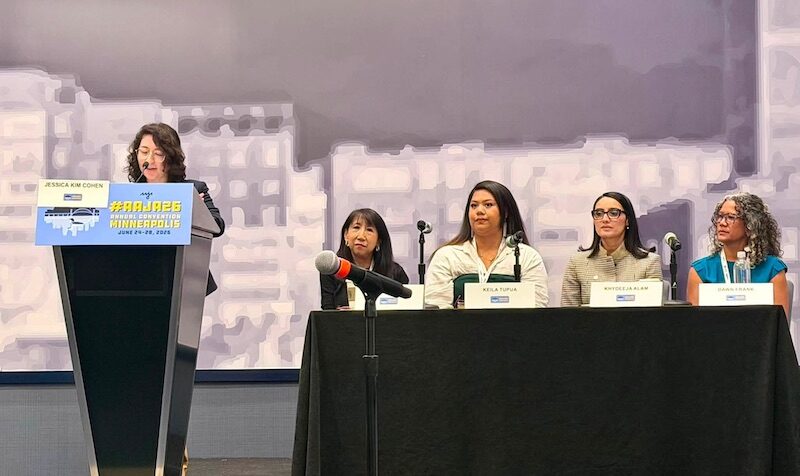
More than 1,200 journalists, students, educators, and media professionals gathered at the Hyatt Regency Minneapolis from June 24–28, 2026, for the Asian American Journalists Association (AAJA) National Convention. Under the theme “Deep Roots, New Routes,” attendees participated in more than 70 sessions featuring over 200 speakers, exploring how journalism is evolving amid rapid technological change, political polarization, and declining public trust while remaining committed to serving communities and defending democracy.
A central focus of the convention was the changing landscape of Asian American reporting. Sessions encouraged journalists to move beyond episodic coverage and produce deeper, more nuanced reporting that reflects the diversity, complexity, and lived experiences of AAPI communities. Throughout the conference, speakers emphasized that authentic relationships with communities are essential to accurate and meaningful journalism.
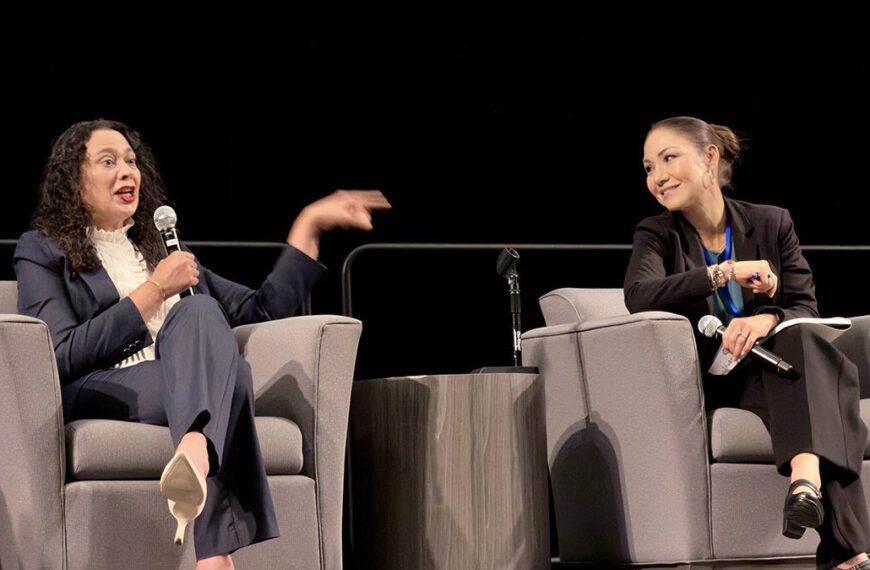
During one of the convention’s featured sessions, Asian American Unity Coalition presented: “From Crisis to Coalition: Lessons from the Front Lines.” Anjuli Cameron, CEO of SEWA-AIFW, and Ted Fong, Executive Director of AAUC, examined how Minnesota’s cross-sector coalition responded during Operation Metro Surge by bringing together immigrant organizations, elected officials, faith leaders, legal advocates, and community organizations to protect civil rights. Participants explored practical lessons in coalition building and discussed how journalists can better understand and report on communities responding to crisis through collective action.
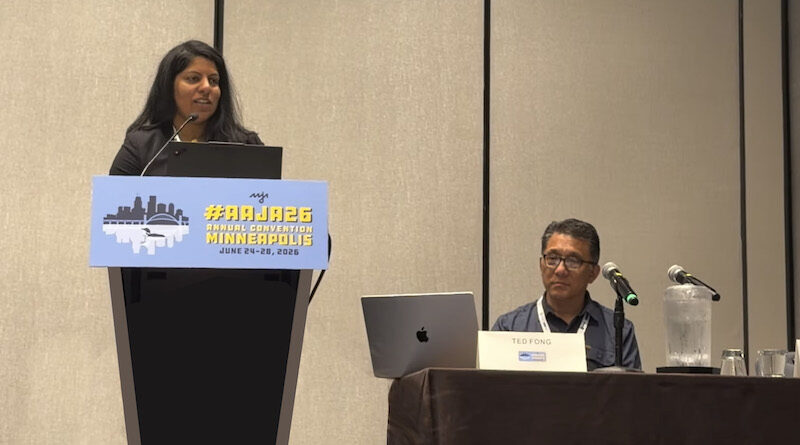
Anjuli Cameron, CEO of SEWA-AIFW and Ted Fong, Executive Director of AAUC, gave a presentation on the Minnesota Model of Cross-Sector Coalition Building.
Artificial intelligence emerged as another dominant topic. Presenters explored the responsible use of AI, demonstrating how newsrooms can use AI to improve research, transcription, translation, and production workflows while maintaining strict editorial oversight. The consensus was that AI should enhance, not replace, the judgment, ethics, and accountability of professional journalists.
The convention also highlighted the industry’s transition toward digital-first storytelling, with sessions examining video, podcasts, newsletters, mobile platforms, and social media strategies for reaching younger audiences. Speakers emphasized that while distribution platforms continue to evolve, strong reporting and compelling storytelling remain journalism’s greatest assets.
The opening session showcased the enduring value of investigative and local journalism through a discussion of the Baltimore Banner’s Pulitzer Prize-winning investigation into Baltimore’s overdose crisis. The panel demonstrated how local accountability reporting can expose systemic failures and create lasting public impact.
Other sessions focused on reporting with community expertise, encouraging journalists to build trust with the people they cover rather than simply reporting from outside their communities. Workshops on misinformation and verification provided practical tools for fact-checking, authenticating AI-generated images and videos, and strengthening public confidence through transparency and rigorous verification practices.
Recognizing the pressures facing today’s newsrooms, AAJA also devoted significant attention to journalist safety and resilience, addressing burnout, trauma, mental health, layoffs, and career sustainability in an increasingly demanding profession.
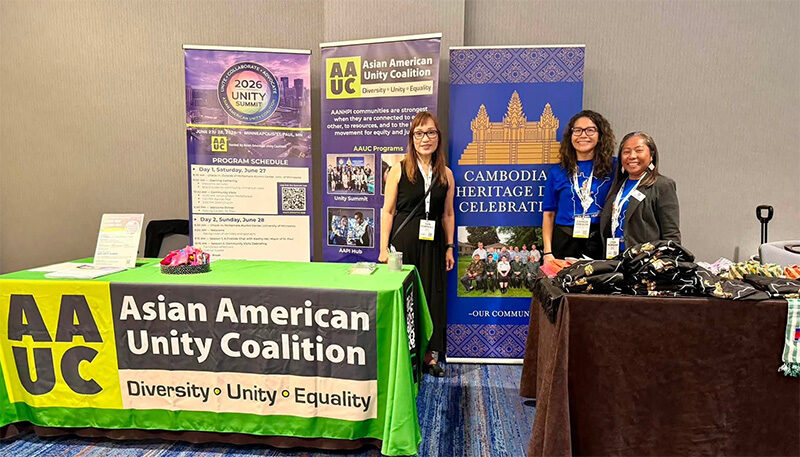
AAUC and Cambodian American Partnership of MN sponsored the Welcome Reception.
Veteran journalist Ann Curry was among the convention’s most influential voices. BOMBSHELL, the documentary she narrated, examined how the U.S. government shaped public narratives surrounding the atomic bombings of Hiroshima and Nagasaki. Following the screening, Curry joined director Ben Loeterman, producer Gaia De Simoni, photojournalist Darrell Miho, and moderator David Ono for a thoughtful discussion on historical framing, media responsibility, and the journalist’s obligation to pursue truth.
Curry also headlined the Gala Scholarship & Awards Banquet, where she received AAJA’s 2026 Visibility Award. In a conversation with MSNBC anchor Richard Lui, she reflected on identity, storytelling, and journalism’s public service mission. She urged journalists to fight for stories that matter most and reminded attendees that reporters must strive to be “worthy of a profession like journalism,” one that carries the profound responsibility of telling other people’s stories.
Closing the convention, outgoing AAJA President Nicole Dungca summarized the gathering’s purpose: “As the media industry continues to change rapidly, and journalism and democracy around the world are under pressure, AAJA’s role in supporting and connecting AAPI journalists is more necessary than ever.” Her remarks reflected the convention’s overarching message: while technology and newsrooms continue to evolve, journalism’s future will be defined by integrity, innovation, and trusted reporting.