
“We should have gotten off our ass several years ago, if not decades. And we have let this thing fester and build and grow. We have to go fight this. And this fight will not happen with Asians alone, with immigrants alone, but it must happen with the African American community. It must happen with the Latino community. It must happen with every group that’s out there.”
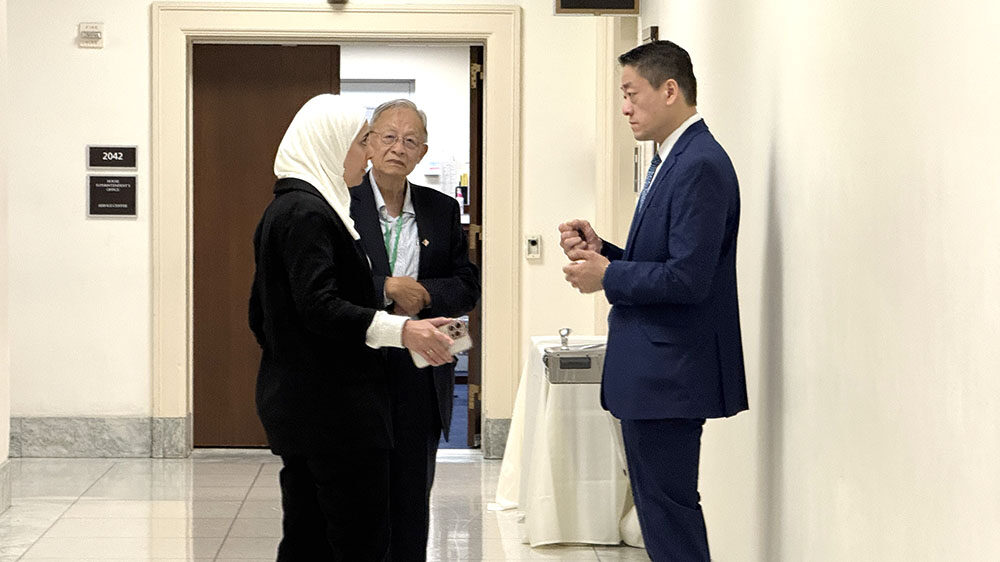
Texas State Representative Gene Wu’s fiery address at the 2025 Unity Summit illuminates the intense political battles he’s waged in Texas. On September 17, at the Rayburn House Office Building, in Washington, D.C., he delivered a powerful call to action for Asian-Americans and other minority groups nationwide.
Confronting Power in Texas
Representative Wu’s leadership in a state where one party controls nearly all levers of power, from the Governor’s office to majorities in the House and Senate, is a monumental effort. He’s had to confront a deeply entrenched political establishment. A prime example of this struggle was the legislative attempt to implement anti-alien laws, measures reminiscent of discriminatory laws from a century ago. Wu recounted how he initially led a charge, organizing the Asian-American community in a truly empowering and effective way that successfully prevented the legislation’s passage for an entire year.
However, the opposition ultimately prevailed this recent year, showcasing the overwhelming power of the opposing side. As Wu noted, Republicans poured four times more effort into passing the law, with the President himself getting involved. Even politicians who privately admitted the laws were wrong felt compelled to vote for them.
This legislative success has had immediate real-world consequences. Wu, whose law firm represents many businesses, mentioned that several clients—Chinese, Korean, and others with significant investments—are now questioning whether to pull up roots and leave Texas, demonstrating the law’s chilling effect on economic activity. The ultimate fear, Wu warned, is that these state laws will be replicated at the national level, threatening the rights of immigrants across the country.
Gene Wu also addressed his state’s most recent controversy involving redistricting. He mentioned that this fight is part of the larger effort to suppress the power of rising minority groups, specifically Black and Latino communities, because the opposing party doesn’t see Asians as a threat politically since they don’t vote as much.
He gave two specific examples of how the redistricting effort worked to dilute political power:
Black Communities: In Houston, they took two powerful Black communities, CD8 and CD9, and smashed them together, effectively ensuring that these two distinct communities could only elect one leader instead of two.
Latino Communities: They chopped up previously Latino-majority communities that controlled their primaries and who got elected. These parts were then stuck with other white communities, ensuring that while they might technically be Latino-majority, they are designed never to elect a Latino representative.

The Historical Playbook of Division
Wu argues that the current political attacks on Asian-Americans are not new. They are simply the latest iteration of a historical playbook used to suppress rising minority groups. He drew a stark parallel between the historical targeting of African Americans and Latinos and the modern strategy directed at Asians.
When African Americans and Latinos achieve positions of power, they are often dismissed with labels like “affirmative action” or “DEI”. For Asian-Americans, who often outperform in metrics like education, the attack shifts: they are instead labeled as “spies,” “traitors,” or culturally incompatible with American life. Wu stressed, “At the end of the day, it is about race.”
This strategy is a revival of practices like the original Alien Land Laws, which were repealed after the Civil Rights Act only to be put back into place today. He highlighted the terrifying similarity in the justifications used: that Asians are “dangerous,” “not to be trusted,” and should be feared based on how they look, a rhetoric tragically familiar from the COVID-19 pandemic.
Wu urged the community to overcome their historical ignorance, noting that the Chinese Exclusion Act of 1882 didn’t just ban Chinese people, but was part of a larger system that only allowed 105 Asians into the country per year until the policies were fully repealed in 1965.
He also addressed the root of current elite anger: the rise of Asian-American success, particularly in education. With Asian-American enrollment at top schools like UC Berkeley nearing 45%, Wu argued, “Who are we pushing out? It’s not just white families. It’s powerful white families, rich white families.” This competition, he asserts, fuels the rising resentment and the desire to curb the community’s growth.
A Call for Unity and Action
Wu’s message is a clear-eyed rejection of apathy. He challenges the community to move past the belief that “This is America. Nothing ever bad happens here.” He outlined a simple, powerful, three-step strategy for every grassroots organization and individual:
Educate: Learn the “brutal, terrifying, and horrific” history of how Asian-Americans and other minorities have been treated.
Organize: Create communication channels to keep communities informed on political attacks and hate incidents.
Take Action: Engage in any civic activity, from writing letters to protesting.
His most powerful appeal, however, is for unity. Asian-Americans, despite being the fastest-growing population in the nation, do not have the political power to fight this battle alone. The path to victory, he insists, is recognizing that “it is the same boot on all of our necks,” whether that of the African American, Latino, or Asian community.
“This is a fight for our lives,” Wu concluded, urging everyone to “get off their ass” and engage, before the country moves to a “two-tier system where immigrants and minorities live in one level and everyone else lives in another.” The urgency is now.



Gene Wu is a rarity in Asean American community. He is a good example of Asean Americans to get involved and participated in many public activities. He defends our civil rights and freedom for the Asean Americans. We need to unite under his leadership to be better.