
Against the backdrop of the war in Iran, more than two dozen community members, organizers, and civic leaders gathered online on March 19th for “In Challenging Times, Our Voices Matter,” AAUC’s third town hall of 2026.
The original program had been designed to celebrate AANHPI contributors to the U.S., a fitting theme as the nation approaches its 250th anniversary. But the U.S. and Israeli military strikes on Iran changed that. AAUC Executive Director Ted Fong acknowledged, “We would have been remiss if we conducted this without even talking about the war, because the war sets the stage for a lot of issues, not just globally, but locally.”
Before diving in, Fong asked participants to describe the current global climate in one or two words. The responses came quickly, and they were unsparing: dystopian, dysfunctional, chaotic, divisive, disappointment, uncertain, and crazy times.
Why Are We at War?
Jack Hanna, a retired attorney, AAUC’s vice president, and a man of Arab American heritage, gave the sharpest legal framing to the war discussion. Drawing directly on the Constitution, he noted that the power to declare war rests with Congress, and that this foundational check had once again been bypassed. “This is an erosion of what the intent of the founders of our country established,” Hanna said, “in order to prevent ambitious, improper military actions against foreign countries, which is what I think we have exactly here today.”
He went further, questioning not just the legality of the war but its strategic coherence. “The reasons for the war are changing moment by moment,” he said. “Is it because of ballistic missiles? Is it because of suppression of civil rights of the Iranian people? Does it have to do with nuclear materials? Is it regime change? This is a reflection of a government that’s making it up on the spur of the moment.”
Voices from the Community
The discussion that followed was wide-ranging and deeply personal.
Benny Lee, a veteran of local politics, reflected on the collapse of the political center and what it has cost the country. “When I got into politics, there was always 20 percent on the left, 20 percent on the right, and 60 percent in the middle, and that has eroded significantly,” he said. Where that middle once held, he argued, the country has drifted toward the extremes, making the kind of deliberate, consensus-driven governance the founders envisioned increasingly difficult to achieve. “We’ve taken three steps forward and four steps back.” Lee returned, as Hanna had, to the Constitution, “It begins with ‘We the People,’ and it’s no longer about the people.”
Sing Lo, who has lived in the United States for 60 years, was succinct and cutting: “I’m not too sure it’s the country that I knew when I was here 60 years ago.”
Kim Sin, a leader in the Cambodian community in Rochester, Minnesota, said the war in Iran has already driven up gas prices and everyday costs, hitting Asian American seniors on fixed incomes especially hard. The federal freeze on Medicare and Medicaid programs has cut off services for the elderly and people with disabilities, with no clear end in sight. “There’s money for war,” he said, “but there’s no money for the people living in the U.S.” Kim also explained why Cambodian and Laotian Americans are often less vocal about advocating for themselves. “In Cambodia, it was the Khmer Rouge. Anything you say or anything you do, they’ll execute you. So, they learned to be silent.” That silence, he made clear, is a generational wound and one the community is now working to overcome.
Fong connected with Sin’s comments by saying he had just returned from the Southeast Asian Freedom Network’s Uniti Fest in Sacramento, held on the 50th anniversary of the end of the War in Southeast Asia. “Most of the attendees were young Hmong, Cambodian, and Laotians who were still deal with their families’ escape from these countries. “The thing that you heard was, ‘We escaped the very thing that’s happening to us now. Our families came to a country with a dream that seems to be forsaken.’”
Carla Mays, from #SmartCohort based in California, drew a sharp contrast between U.S. policy priorities and those of Asian nations like Singapore, Japan, and China. “We’re so distracted by our old way of doing things,” she said. “In Asia, there’s always talk about healthcare, housing, transport — investments that keep people alive. Here, those things aren’t important.” She warned that the current administration’s budget priorities would shred an already thin safety net.
Marsha Golangco, who immigrated from Hong Kong decades ago, reflected on a sense of national fragmentation. “Each of us has our freedoms including, our own opinions. But as a people, we are not together,” she said. “I call it a decline of the American empire. It’s not well.”
Hedy Tripp, joining from St. Cloud, Minnesota, offered a reminder of Iran’s ancient civilization and its deep global ties. “Persia is an ancient, ancient civilization,” she said. “Persians and Mediterranean, African communities have all been trading and connecting themselves all over the world, including Asia. We have ties to Iran, globally as well.” She also raised a pointed question: how do we shift America’s narrative to treat people, not weapons systems, as the nation’s primary asset?
Fong added his own blunt perspective, “I just don’t see, given our historical record, how we can bomb other countries into democracy. We failed to do that in Vietnam, Afghanistan and in many other places.”
Champions of Democracy, The AANHPI Legacy
With the weight of the present firmly established, the town hall pivoted to its core program: a review of AANHPI figures who have upheld democracy, rule of law, and governance, from the 19th century to today.
Jack Hanna led with Wong Kim Ark, the San Francisco-born man whose late 19th-century legal battle established the constitutional right to birthright citizenship. The case is newly urgent. President Trump’s executive order challenging birthright citizenship is set for Supreme Court argument on April 1st, with a decision expected by late June. “Tens of millions of immigrants since then have birthright citizenship for their children who were born here,” Hanna noted, adding that despite winning his case, Wong Kim Ark was continuously harassed, and his son was deported years later. “The remnants of prejudice continued.”
Hanna then profiled Fred Korematsu, who in 1942 refused to comply with the executive order incarcerating 120,000 Japanese Americans, was arrested, and fought his case all the way to the Supreme Court and lost, in one of the worst decisions in American judicial history. Decades later, newly discovered military records proved the government had concealed evidence that Japanese Americans posed no security threat. In the early 1980s, Korematsu reopened his case, won, and successfully advocated for reparations. “Now we see that detention camps are already being reconstructed,” Hanna observed. “Fred Korematsu’s legacy is impacting us today.”
Hanna also honored Corky Lee, the self-taught New York photographer who for 50 years documented Asian American communities without profit or fanfare, often borrowing cameras to get the job done. “We must document what’s happening,” Hanna said. “We have to show and expose when wrong and improper actions are being committed. His work is a pathway to protecting ourselves and our communities going into the future.”
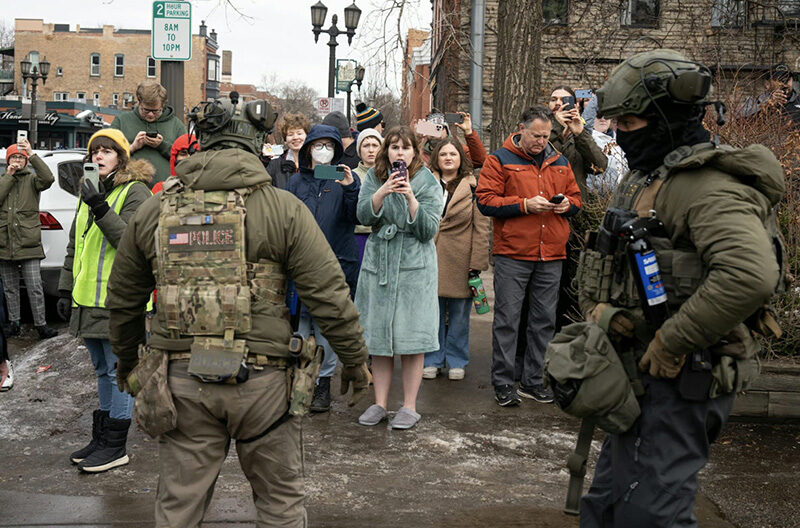
Fong spotlighted Kaohly Her, the newly inaugurated mayor of St. Paul, Minnesota, born in a bamboo hut in Laos, raised as part of the Hmong diaspora created by U.S. military operations, and thrust into the national spotlight just three days after taking office when the first ICE-related killing occurred in her city. As she took to the national stage, her response was swift and steady. She passed ordinances prohibiting ICE activity on city property and required masked law enforcement to identify themselves. “Her family described her as a protector, tough, and one who never took crap from anybody.” In person, however, people report that she is cordial. “Her temperament is perfect for a job like that,” Fong said. “She is a good example to all immigrants that they can have a place at the table.”
Hanna reserved some of his deepest admiration for civil rights activist and author Helen Zia, who spoke at the AAUC’s national summit last summer and whose decades of advocacy span virtually every major social justice movement of the modern era. Her activism began at Princeton in the late 1960s, where she was among the first women admitted, connecting immediately with Black and Latino communities and opposing the Vietnam War. In the early 1980s she organized the country around the unlawful killing of autoworker Vincent Chin. He said, “Her coalition-building across communities of color established a model of solidarity that continues to define how AANHPI communities respond to injustice, discrimination, and hate.”
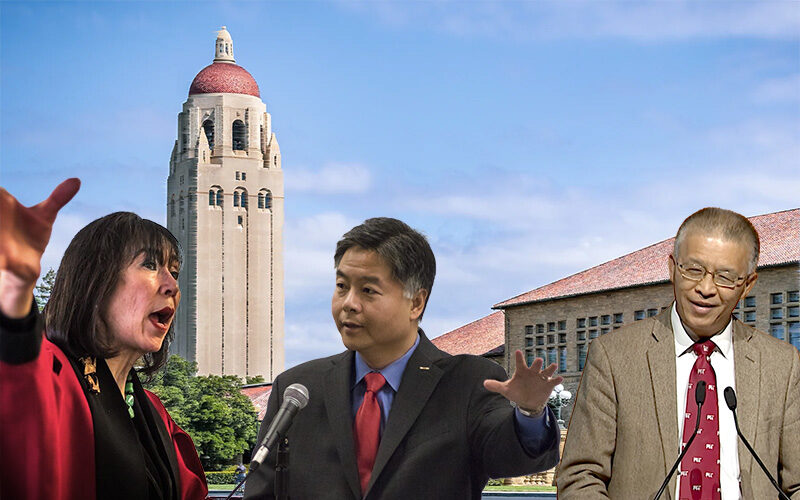
The program also covered Texas State Representative Gene Wu, Congresswoman Pramila Jayapal, Congressman Ted Lieu, John C. Yang of AAJC, and Karthick Ramakrishnan of AAPI Data.
SK Lo’s Closing Word
AAUC Board Chair Dr. SK Lo was given the final word.
“The town hall reminds us of a very simple but powerful truth,” Lo said. “Asian Americans have always played a very essential role in safeguarding the nation and strengthening democracy, especially in times of conflict and uncertainty. Our community has served and led and sacrificed, even when our contributions are overlooked and our loyalty is questioned.”
She called the current moment “a redefining time,” and issued a direct call to action: “We should not be a silent minority. We are a vibrant, engaged, and essential part of America’s story. Our voice matters more than ever. Together, we need to lead, to serve, and to stand for the values that define this country.”
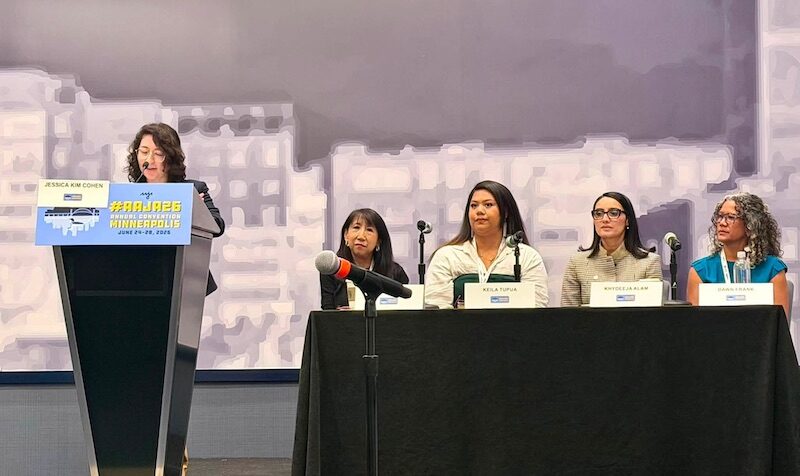
The AAUC will hold its next town hall on April 16, 2026. AAUC’s 2026 Unity Summit, “From Crisis to Coalition: Lessons from the Front Lines,” is scheduled for June 27–28 in Minneapolis, with community visits to Hmong, Latino, and Somali leaders on day one, and presentations and networking at the University of Minnesota Alumni Center on day two. Visit the event page.