By Ted Fong, Executive Director, AAUC
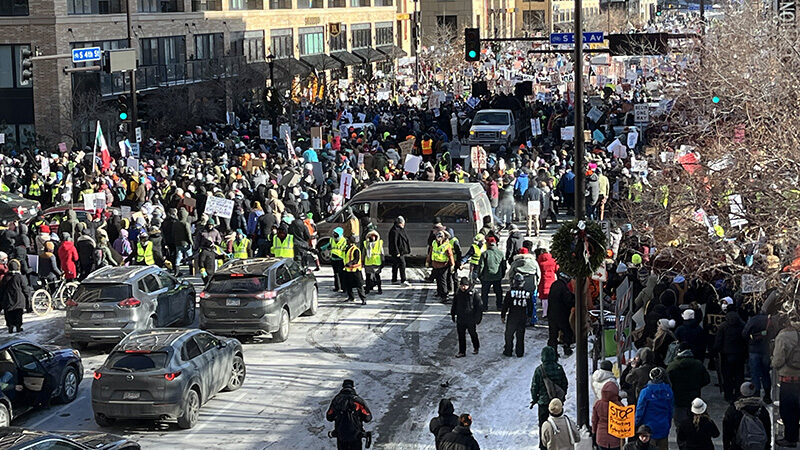
Community leaders and immigrant advocates from across the U.S. gathered on January 15, 2025, for an online town hall addressing the fatal shooting of Renee Nicole Good, a U.S. citizen killed by an Immigration and Customs Enforcement (ICE) officer in Minneapolis. The meeting, organized by the Asian American United Coalition (AAUC), brought together 42 participants from across Minnesota, Maryland, California, Virginia, Texas, Alaska, Ohio, Wisconsin, and Illinois to confront the shooting and the broader escalation of ICE enforcement in Minnesota.
The town hall marked AAUC’s first public forum responding to Good’s death. It included representatives from Council on Asian Pacific Minnesotans, Vietnamese Social Services of Minnesota, the Coalition for a Better Chinese American Community, Cambodian-American Partnerships of Minnesota, SEWA–AIFW, Asian Media Access, My Sister’s House, Global Organization of People of Indian Origin, Afghan Support Network, and other immigrant-serving organizations. It served as a gathering space to express outrage and to discuss accountability, safety, and collective action.
AAUC President Yen Marshall opened the meeting by framing Good’s death within a larger national context. Marshall emphasized that the shooting could not be separated from expanding federal enforcement powers and increasing violence associated with immigration operations. She stressed the need for solidarity across communities and sustained organizing rather than isolated responses.
Fear Extending Beyond Immigration Status
Dr. SK Lo, founder and board chair of AAUC, described a climate of deep fear and uncertainty spreading throughout Minneapolis and St. Paul. She noted that anxiety is no longer confined to undocumented residents, but now affects refugees, green card holders, naturalized citizens, and U.S.-born individuals.
According to Lo, the killing of a U.S. citizen has intensified concerns about safety and civil rights for everyone. She called for stronger trust and cooperation across the diverse Asian American and Pacific Islander (AAPI) communities, urging organizations to share information on safe practices and legal protections.
Ongoing Impact of Trump-Era Immigration Policies
Several speakers pointed to the continued effects of Trump-era immigration policies on Minnesota’s immigrant and refugee populations. KaYing Yang described how Somali and Southeast Asian communities have faced heightened ICE enforcement, compounded by the termination of Temporary Protected Status (TPS) for Somali migrants.
Yang explained that these policies have generated widespread fear while also fueling resistance and organizing efforts. She highlighted the importance of Know Your Rights trainings and noted that Asian Americans are often excluded from public narratives about immigration enforcement, despite being directly impacted.
Federal–Local Tensions After the Shooting
Andrew Morris, Legislative and Public Affairs Director at the Council on Asian Pacific Minnesotans, discussed growing tensions between federal authorities and state and local governments following Good’s killing. He cited the lack of cooperation between the FBI and the Minnesota Bureau of Criminal Apprehension as a serious concern in the investigation.
Morris also reported that ICE staffing levels in the Twin Cities currently exceed the number of Minneapolis police officers, contributing to widespread fear. He raised alarms about arbitrary detentions and recent federal actions to halt visa processing and review refugee status, which have further destabilized vulnerable communities.
Resource Fears and Historical Trauma
Concerns about retaliation and funding cuts were also raised. Morris noted that some state-funded officials are hesitant to speak publicly, while community organizations receiving federal grants through the Department of Homeland Security fear indirect consequences.
Kim Sin, representing Cambodian-American Partnerships of Minnesota, described how ICE activity in Rochester has reawakened trauma rooted in the Khmer Rouge era. Community members, he said, are avoiding public spaces and daily routines. In response, organizations have established food delivery systems and are sharing information about available city and county support.
Hue Pham, the Executive Director of Vietnamese Social Services, shared similar experiences from the Vietnamese refugee community, where recent events have triggered memories of war, displacement, and escape from political violence. Despite fear and mistrust, Hue emphasized the role of mutual aid, community visits, and food distribution in maintaining connection and hope.
Arrests Continue Despite Legal Challenges
Darwaish Zakhil, a community organizer for the Afghan Support Network, working with immigrant families, reported that ICE arrests continue despite expectations of temporary restraining orders. He described heightened anxiety across communities and ongoing organizing efforts, including a webinar expected to reach more than 100 participants on how to interact with ICE and safely carry documentation.
Darwaish also shared that their organization is handling multiple cases involving Afghan community members, including individuals who have already been detained.
Chen Zhou described divisions within the Chinese community, shaped in part by misinformation and differing political perspectives. Sing Lo urged leaders in other states to speak out, warning against allowing Minnesota to become an example meant to intimidate others. He described the state as being treated like a “chicken” and referenced poetry about the dangers of remaining silent under authoritarian conditions.
Moving From Fear to Action
The town hall concluded with a focus on practical community safety measures. AAUC VP Jack Hanna outlined steps individuals should take if approached by ICE, including remaining calm, asking whether they are being detained, and exercising the right to remain silent if arrested. He also emphasized that U.S. citizens have rights during ICE encounters and should be prepared to assert them.
Mithun Banerjee connected the discussion to broader civil liberties issues, sharing his own experience with police violence and encouraging greater political participation, including running for elected office. He is in the race for County Executive in Montgomery County, MD. Yuxing Wang of Aware Ohio announced an upcoming panel on pan-Asian solidarity taking place that afternoon and invited collaboration from other communities.
AAUC leaders closed the meeting by committing to monthly town halls and continued advocacy through writing, public discussions, and media engagement. Participants agreed that the death of Renee Nicole Good demands not only remembrance, but sustained pressure for accountability, transparency, and protection of civil rights for all communities.