By SK Lo
Every year, as winter gives way to the promise of spring, billions of people around the world mark the arrival of the Lunar New Year, known widely as the Chinese Spring Festival. While rooted in centuries-old traditions, today’s celebrations reveal a fascinating blend of ancient folklore, modern technology, and the diverse ways communities across the world interpret and honor this important cultural holiday.
The Lunar New Year remains the largest annual human migration on Earth. In 2024 and 2025, reports estimated 7–8 billion individual trips over the 40-day travel period known as Chunyun, far eclipsing anything seen in Western holiday travel. This massive movement reflects the enduring importance of family reunion in Chinese culture. No matter how far people journey for work or study, returning home for New Year’s Eve dinner remains non-negotiable for many, a cultural heartbeat that has not faded with modernization.
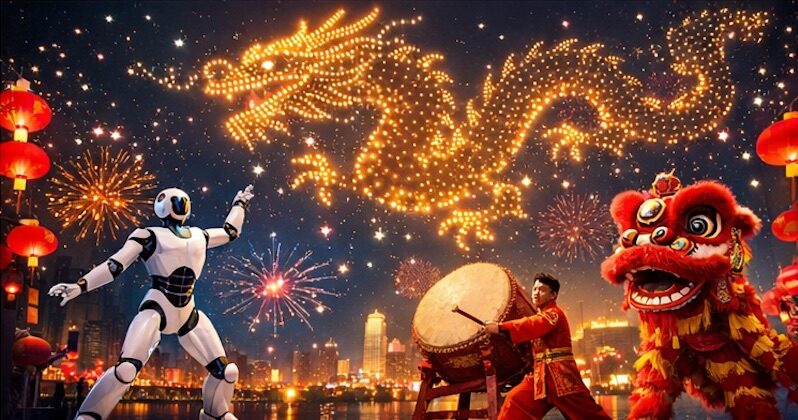
Today’s China celebrates with dazzling scale and cutting-edge technology. Drone shows illuminate entire city skies, forming intricate 3D images and animations. Robotic performers appear alongside cultural artists on televised galas. Major cities host massive parades combining traditional opera, martial arts, and contemporary choreography. Fireworks, still an iconic symbol, continue to thunder across the landscape, although many cities now balance them with environmentally friendly laser or drone displays.

It is a celebration where old and new do not compete. They coexist, reinforcing the idea that cultural heritage can evolve without losing its soul.
Despite technological transformation, the foundational stories remain alive. One of the most beloved is the tale of Nian, a terrifying sea monster said to emerge each New Year to terrorize villages. According to folklore, the creature feared loud noises, bright fire, and the color red. To protect themselves, villagers banged drums, lit firecrackers, hung red couplets on their doors, and later created the costumed lion and dragon dances that have become iconic.
These customs: fireworks, festive red attire, rhythmic drum, continue today, serving as a reminder of resilience, unity, and renewal.

Photo by RM on Unsplash

Photo by Chen Heng on Upsplash
While the energy in China is spectacular and larger-than-life, Lunar New Year celebrations across the global diaspora tend to be more modest. Many families outside Asia do not have public holidays for the festival, so the observances often center around:
- Shared family meals, usually on a single evening rather than 15 days of festivities.
- Red envelopes (hongbao) filled with lucky money for children and younger relatives.
- Auspicious greetings, wishing prosperity, longevity, and good fortune.
- Community-hosted lion or dragon dances, accompanied by drums and cymbals, often in cultural centers, school gyms, or local plazas.
- Cultural fairs, showcasing calligraphy, crafts, and traditional performances.
These diaspora celebrations may be quieter, but they carry immense emotional meaning. They keep cultural roots alive and offer younger generations an anchor to identity in multicultural societies.
Like many living away from our home country, I often feel a twinge of nostalgia during the Spring Festival season. I miss the immersive atmosphere of the nonstop firecrackers, the bustling markets, the scent of festive foods drifting from every home. At the same time, I do not miss the overwhelming travel crowds or the logistical chaos that comes with billions of trips crisscrossing the nation.
What remains universal, however, is the heart of the celebration: family, renewal, and connection. Whether marked with drones and fireworks or with a simple shared meal, the Lunar New Year continues to remind us of where we come from and what we carry forward.

Photo by Remi Chow on Upsplash